
Navigating a Strategic Inflection Point
Practical tips and further reading for busy managers

In my last post, which raced to 6,000 hits in a few hours, I wrote about strategic inflection points. I promised to follow up with a more ‘how-to’, practical guide for the busiest of bees amongst you. Today’s post is that guide.
To begin with, we’ll discuss the structure of an inflection point and the lessons Grove took from Intel’s memory crisis. Secondly, we’ll linger on the most important lesson of them all, that the best way to navigate an inflection point is to prepare for it. Finally, we’ll see that how a team reacts when the moment arrives dictates how successful the inflection point is navigated.
Structure of an inflection point
Strategic inflection points are crises, which means, like a good novel, they have a beginning, a middle and an end. Unlike a good novel, you don’t know when the end comes. ‘Strategic inflection points’ are therefore a misnomer: they are not points at all but rather long tortuous struggles. In Only the Paranoid Survive, on page 95, Grove makes this point clear and you should not discount that.
Just in case you are thinking, ‘shit, I don’t know how to manage a crisis’, let me reassure you. You know more than you think. Crisis management is project management with extra empathy, which for those mathematically minded among you, and following Grove’s example in Only the Paranoid Survive, looks a bit like this:
crisis management = project management + empathyHere is an example of empathy. Intel’s memory crisis ended with Andy Grove visiting the DRAM technology group in Oregon. Led by Sunlin Chou, the group worried the resolution to the crisis, the systematic withdrawal from the memory business, would leave them unemployed. The inflection point had, in other words, written on the walls and Chou’s people wanted answers. Grove visited them and delivered a speech that reassured them that they had a place in the future, not least because their skills were in linewidth reduction and they were better at that than the microprocessor gang. That’s what empathy looks like and Grove deployed it because that team, through no fault of their own, needed reassurances about their futures.
Grove took two more lessons away from that strategic inflection point. The importance of middle managers and just how hard it is to kill something.
Middle managers. Grove said his team, including himself, failed to respond because they were anchored to beliefs born from their earlier successes. As they zombie-shuffled around in denial and depression for a year, Grove said, ‘our production planners and financial analysts dealt with allocations and numbers in an objective world’. Grove understood the importance of middle managers and of giving them the space and resources to succeed (and to fail). We saw the same at Container Solutions when a group of talented managers steered the company through the COVID crisis.
‘It’s easier to start something than to kill it’. These were Andy Grove’s own words. The success of memory anchored Intel to the past, which is why they had so much trouble killing it, and microprocessors were at Intel a second class citizen. Finding an outsider’s perspective is the key to knowing what to kill - more on that in a minute - and what not to start.
Preparing for a crisis
Obviously, Intel built the middle management layer before the crisis arrived. The seeds of Intel’s success, in other words, had been sown years if not decades earlier. One of Robert Noyce’s first bosses, and negative role model, that’s to say an example of how not to manage, was William Shockley. William Shockley won the Nobel Prize for inventing the transistor, which I always find funny, because when I look at the patent, his name is nowhere to be seen:
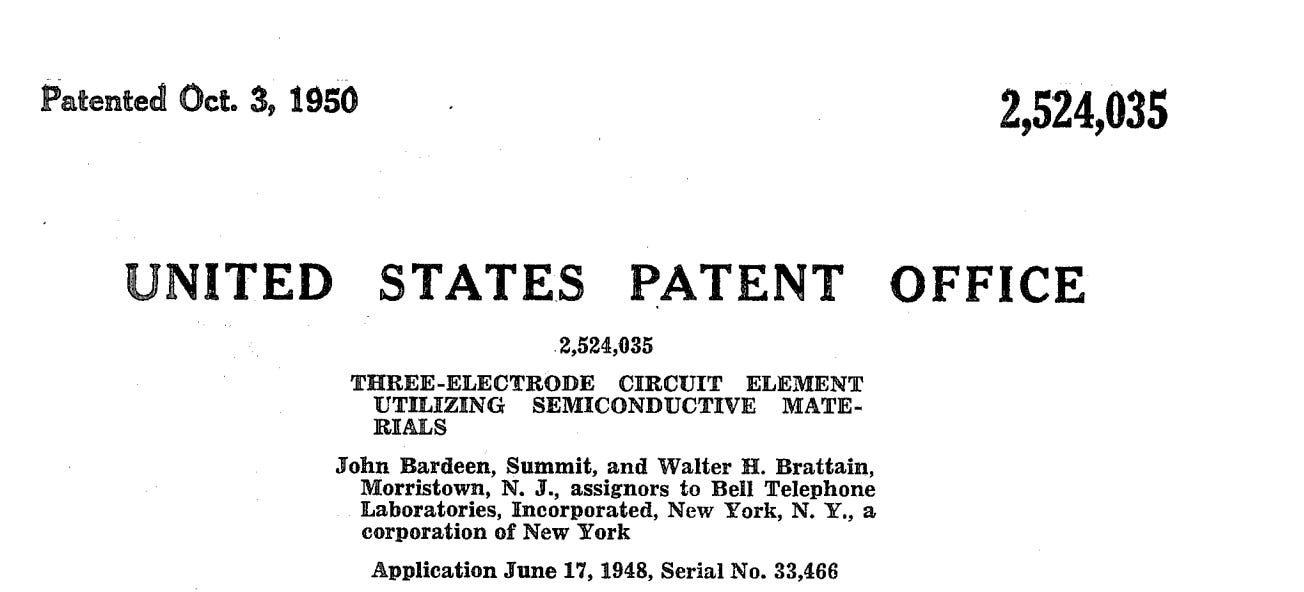
Robert Noyce’ values and upbringing, he was the son of a preacher, collided with Bill Shockley’s paranoia and that satanic union brought forth humanistic management. In Visionaries, Rebels and Machines, I say the following:
Bell Labs took the management of knowledge workers one step further. Within their highly creative walls, researchers were given freedom, support from their bosses, worked in cross-functional teams and were encouraged to follow their hunches. When the science fiction writer Arthur C Clarke visited Bell Labs, he said that it looked like a large, modern factory. However, it was a ‘factory for ideas, and so its production lines are invisible’.
Humanistic management took a more concrete turn at Robert Noyce’s first company, Fairchild Semiconductor. He took the lessons he learned there with him to Intel. In practice, humanistic management meant the sharing of information and the busting of hierarchy. Noyce killed those birds with a bag of similar-shaped stones. Small meetings with the boss, newsletters, lunch in the cafeteria, which was organised along egalitarian principles (like the car park too), and breakfast and coffee meetings. These meetings smashed hierarchy, spread information and created a culture of honesty, cooperation and high motivation. That culture and the supporting meetings blurred the lines between managers and workers and that in turn fostered psychological safety.
When Noyce eventually started to codify these practices, it became obvious that he was trying to find a balance between freedom and discipline. By doing this, Robert Noyce created the blueprint that would emerge all across the computing industry, including at Netflix, where Reed Hastings sought to balance freedom and discipline through talent density, radical candour and low bureaucracy.
When Noyce moved up to the board in the late 1970s, Andy Grove picked up where he left off and demonstrated with his and Intel’s handling of the memory crisis something that Amy Edmondson later proved, namely that psychologically safe companies navigate crises better than those that are not. Crises are, after all, the ultimate failure and therefore the ultimate learning opportunity. Humanistic management grows people through failure and in doing so they learn to learn from failure - when failure arrives, they may not be totally ready but are readier than other, less practiced companies.
How did Intel and how can you prepare for the moment of crisis, the moment the inflection point arrives and the world turns upside down? By practicing failing well. How do you do that? This checklist of what makes a good failure is not a bad place to start:
Failing in a new area. As painful as it sounds, a new medical procedure going wrong is acceptable but nobody expects to die getting their tooth filled. The former is a failure that teaches the latter is not.
Failing towards a new goal. That’s what Intel did with microprocessors. Failure towards something new is a good failure. Failing to file your taxes, assuming you have done that before, is a bit daft to say the least.
Failing with new knowledge. Are your experiments based on new ideas, new discoveries and / or new market information? If so, then you are failing well. If, on the other hand, you are acting randomly or, as one person who ‘experimented’ coming to work on my team late everyday for a week, you are not.
Failing small. Small is good and big is bad.
Thus we get to our second formula.
good failure =

  small experiments
+ based on new knowledge
+ moving towards a specific goal
+ in a new area
Failing well, as per this formula, means when the crisis arrives, you are ready. This is important because in a fast moving world:
Goals become hypotheses and plans become experiments.
That checklist up there is how you design experiments to test hypotheses. Testing hypotheses is how the best companies navigate a crisis.
During the crisis
You now have an idea how to prepare. What about when the crisis arrives? Firstly, you must find an outsider's perspective. Secondly, you must respond as not only is there no time to reflect, it won’t help you much.
Find an outsider’s perspective
Here is another section of VRM, taken from a chapter called ‘Only the paranoid will survive the coming wave’:
In his book, Only the Paranoid Survive, Grove recalled shuffling around in shock for a year. Then, in a meeting in 1985, he asked Moore, ‘If we got kicked out and the board brought in a new CEO, what do you think he would do?’ Without much hesitation, Moore said that new management would get Intel out of the memory business. Grove then asked, ‘Why shouldn’t you and I walk out the door, come back and do it ourselves?’
Grove’s biographer, Richard Tedlow, called this conversation a real moment of truth for Intel and a ‘cognitive tour de force’ by Andy. Why? Grove had managed to do something that hardly any business manager or leader could or would ever do. He had looked at himself, almost as if he was having an out-of-body experience, and tried to judge the situation objectively. This let him frame the situation in a way that nobody at Intel, in the previous full year of bickering, had been able to do. In a flash, Grove could see the future, and after that conversation, Moore could see it too.
Written down like this, finding an outsider’s perspective seems easy but it is not. Like Grove, you will be emotionally attached to your previous decisions and your colleagues who you won’t want to hurt. Many years ago, I was that person, although not in a crisis I could not see the woods for the trees and nor could I see the trees for the woods. Then I took five weeks off to look after one of my kids. By lunch time on my first day back I knew exactly what to do. An out-of-body experience was thrust upon me. That was my good fortune. Will you be so lucky and if not, how will you find an outsider’s perspective?
I advise founders in scale ups to take a month off, if they can, because when they come back they should know what to do next. Grove should have taken a month off when the memory crisis hit. Big mistake.
Don’t reflect, respond
Learning through failure is powerful in the present and powerful in the future because it lets us develop foresight by developing hindsight. When a crisis arrives, though, learning through failure can be dangerous. Grove zombied around for a year in a daze. Depression and victimhood are natural responses to a crisis and reflection can make both of these things worse.
When the moment comes, and I had a chance to practice this during the COVID crisis, the job of the leader is to bring depression to a quick end and move the group forward. The following are good questions:
What can we do, right now, and no matter how small, to improve this situation? In all hands meetings, in 1:1s and through my managers, I asked everyone in the company to answer the question, what can I personally do to make this better? These future oriented questions help people avoid the temptation to blame themselves or to blame others. Blame is a quick fire path to depression and victimhood whereas action is the path out.
How can we contain the negatives of the crisis and, whilst we’re at it, what positives can we dig out? This moves us away from the idiotic pattern Intel got stuck in, to attack the Japanese often with racist undertones, and many are stuck in right now as they hum and haw about whether or not generative AI is here to stay.
Answering the question about containment forces us to be brave now and not later, when it might be too late. Presently, many firms are getting battered by economic headwinds and their leaders look lost and the reason is because their minds are in the past, thinking about Trump’s tariffs, Britain’s exit from the EU or the manager that did not work out in 2024. These are the answers to the wrong questions.
Wrap up
When COVID hit us, I cleared my decks and, after crying and drinking a pack of beer, ordered a bunch of books and was back at my desk by 5 the next morning with a massive blank bit of paper ready to work. By Saturday evening, I had a skeleton plan, a process for keeping the team going and keeping myself going. I had, in other words, my own little tour de force moment and gained an outsider’s perspective.
In those couple of days, I took a lot out of Harvard Business Review Essentials: Crisis Management and ‘How to Bounce Back from Adversity’ summarised well many of the ‘bouncebackability’ practices the team at Container Solutions already implemented. I had previously internalised Only the Paranoid Survive but I dug it back out, of course, and went back over it. If you add to Edmondson’s Right Kind of Wrong to the books and papers I read, then you will not only have a survival kit for when the crisis arrives but guides that will help you prepare for it. Chapter 18 of Visionaries, Rebels and Machines, ‘Only the paranoid will survive the coming wave’ includes a framework for preparing for a future that cannot be predicted.
I hope this satisfies your need for concrete, management and leadership tips. In September I’ll share more reading and somewhere in Q4 a podcast about Intel and strategic inflection points will drop.